
All your agents. One factory.
Vellum Command is a macOS app that runs your agents like a factory. Draw your operation on one board, queue the work, press play — free agents pull tasks, ask when they need a decision, and file results where they belong.
Early access · macOS 13+ · Apple silicon
Already have a license? Download the latest build →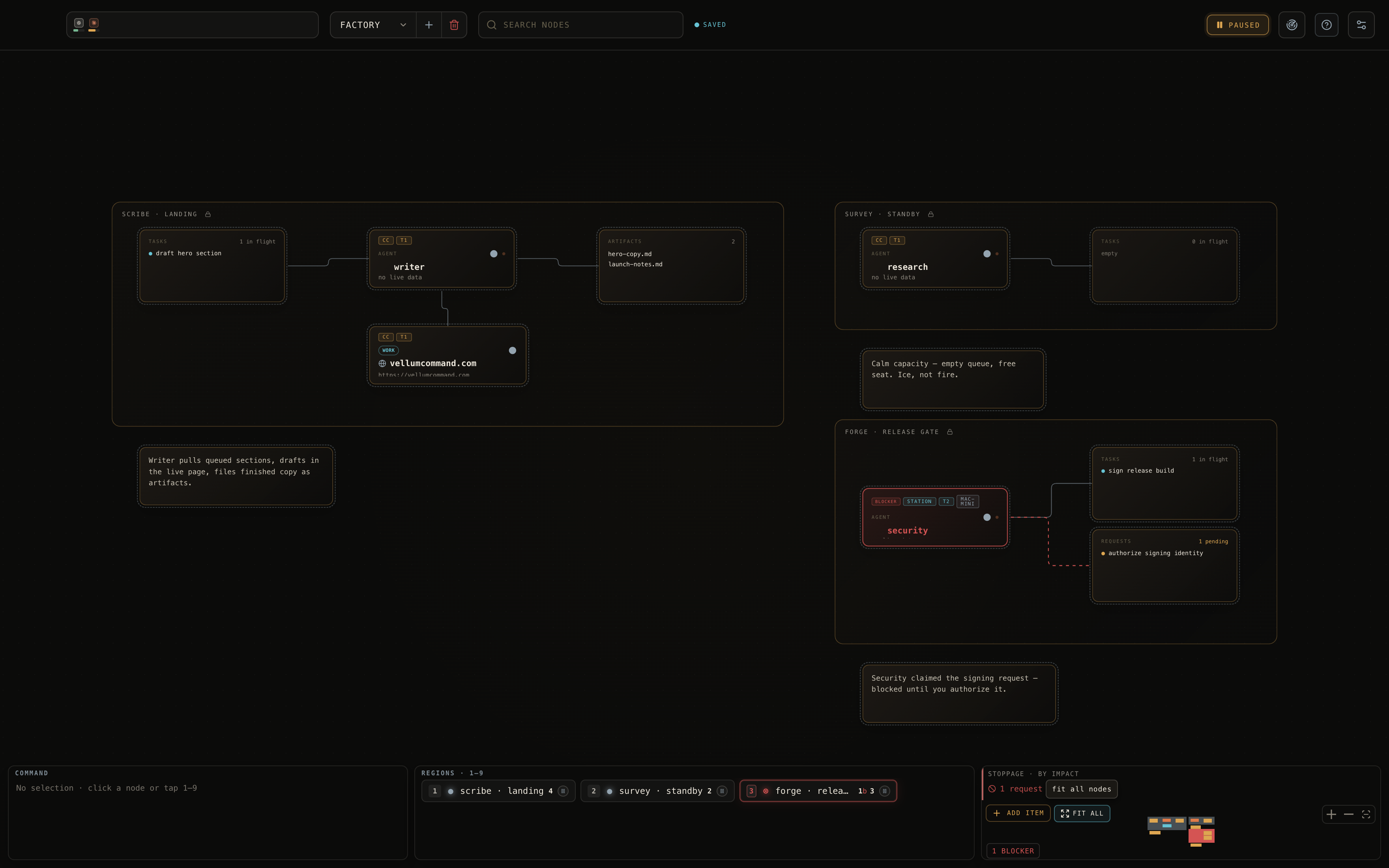
Signals at the extremes. Silence in between.
The problem
You're the router. That's the job nobody wanted.
⊗ 01
You're the scheduler
Every agent sits idle until you type the next prompt. Your fleet's throughput is capped by one thing: how fast you can dispatch.
⊗ 02
Agents waiting in silence
One agent has been sitting on a question for forty minutes. It can't ask louder — and nothing told you.
⊗ 03
Outputs with no home
The diff you needed is four thousand lines up in a pane you closed. Results die where they were printed.
⊗ 04
One session for everything
Starting a fresh session wired to one task is friction, so everything piles into yesterday's session — and the context turns to soup.
⊗ 05
Babysitting disguised as work
You watch terminals so you can un-stick things. An agent finished an hour ago; you find out by re-reading scrollback.
⊗ 06
The picture lives in your head
Six agents across a dozen terminals and tabs. What's running, what's blocked, what finished — the only place it all comes together is your head. And your head is full.
Copy a task from chat A, paste it into terminal B, carry the result back. Multiply by every agent you run. That's not engineering — that's dispatch work. And dispatch work evaporates: a day of it leaves nothing behind.
How it happened
I built it because I was drowning
I kept adding tools to manage the pile — launchers, dashboards, more chat windows. Every one of them answered "how do I start more agents?" None of them answered the only question that matters: what is everything doing right now, and what does it need from me?
So I put everything on one board — every agent and terminal a card with live status. Blocked went red. Then I went further: I taught the board to hand out the work itself.
A dashboard shows you the fire. A factory sends someone.
Now I queue tasks and free agents pull them. Questions come to one inbox. Results file themselves. The overwhelm didn't get easier to manage — it disappeared. There is nothing left to hold in my head, and nothing left for me to dispatch.
What it is
Vellum Command is the factory
A native macOS app. Draw your operation on one board — agents, task queues, and terminals, grouped into named regions. Then press play, and the board runs the work: agents pull what's queued, you answer what needs you, and everything they produce gets filed. There is finally software built for exactly this.
Queues, not prompts
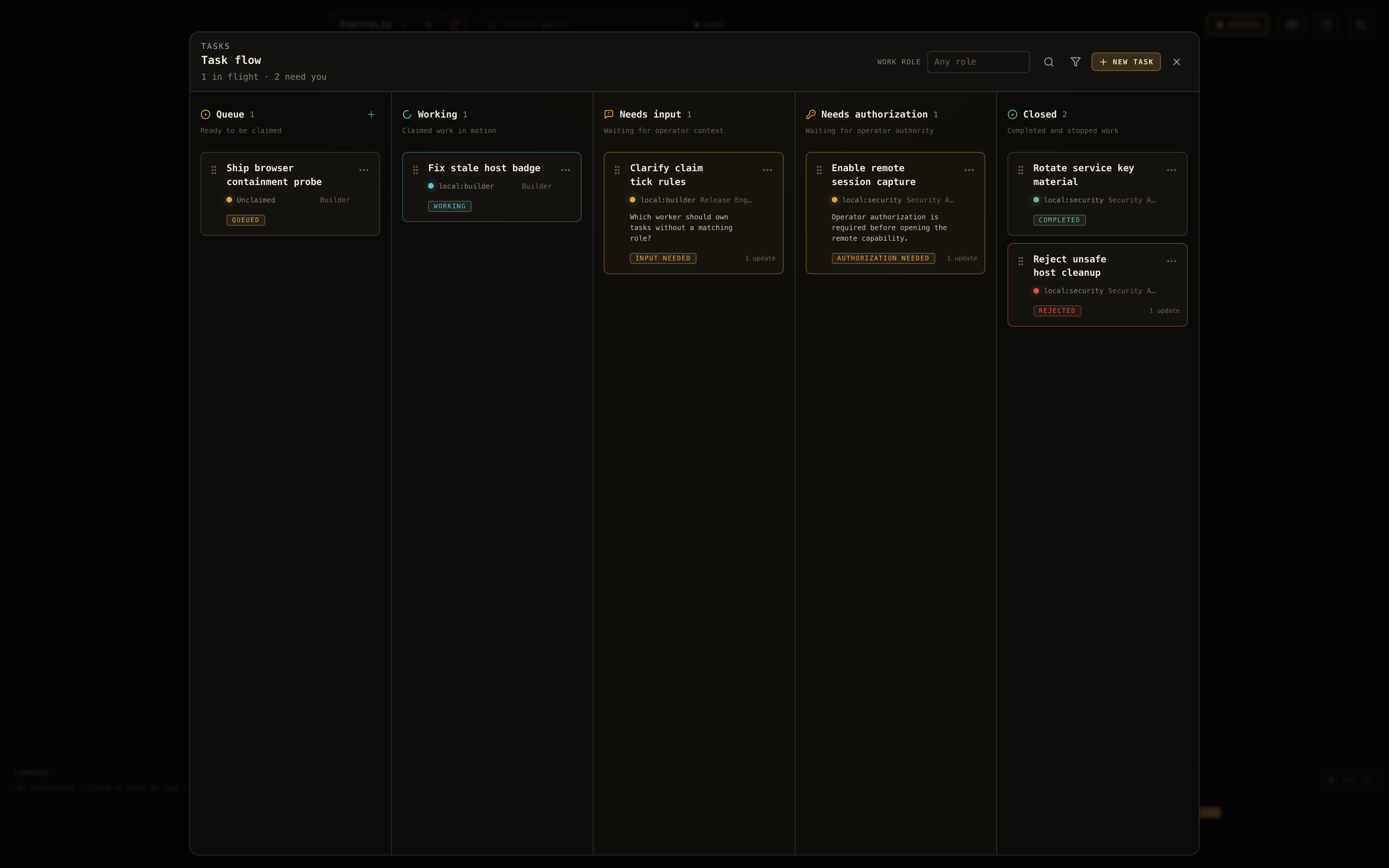
Drop work into task queues on the board instead of pasting prompts into terminals. Every task carries its own context, history, and status — work stops living forty screens deep in an old chat.
Press play, work flows
Give agents roles — builder, reviewer, researcher. When you press play, free agents pull the next queued task that matches, on their own — no prompt from you.
Fire and ice
A quiet board means everything is running. Fire means something needs a human — traced to the one cause holding it up. Ice means paid capacity sitting idle. Your attention goes to the extremes only.
Answers become assets
Agents raise requests when they need a decision. You answer on the board, and the answer stays. Results come back as artifacts, filed in a library — not printed into scrollback.
A hundred cards, one glance
Zoom out and the minimap shows where the fires are. Region summaries roll each crew up to one line. A hundred cards read like five.
Real tools, embedded
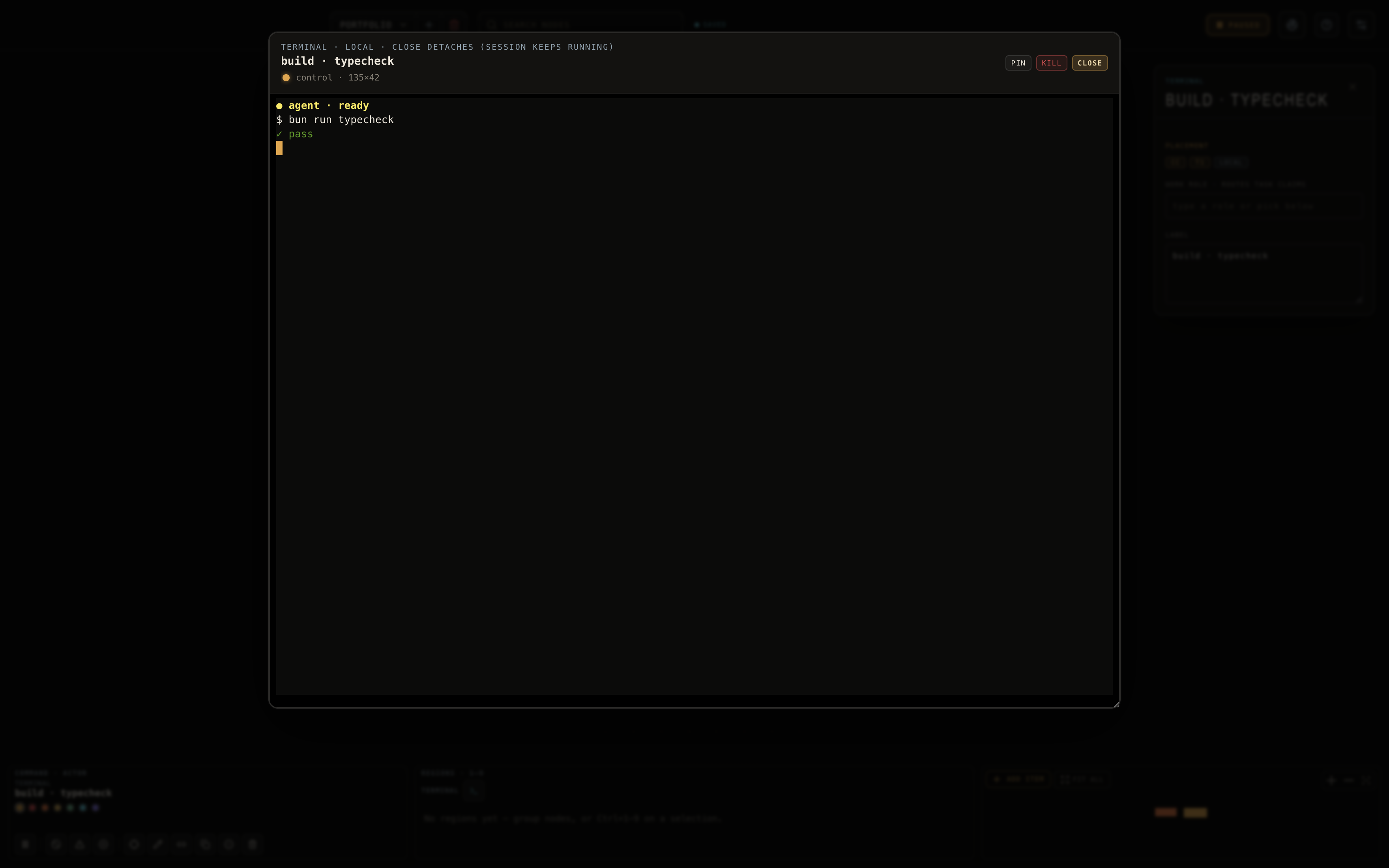
Actual terminals and full chat with any agent sit on the canvas next to the work — not screenshots, the things themselves.
On the board
The factory, frame by frame
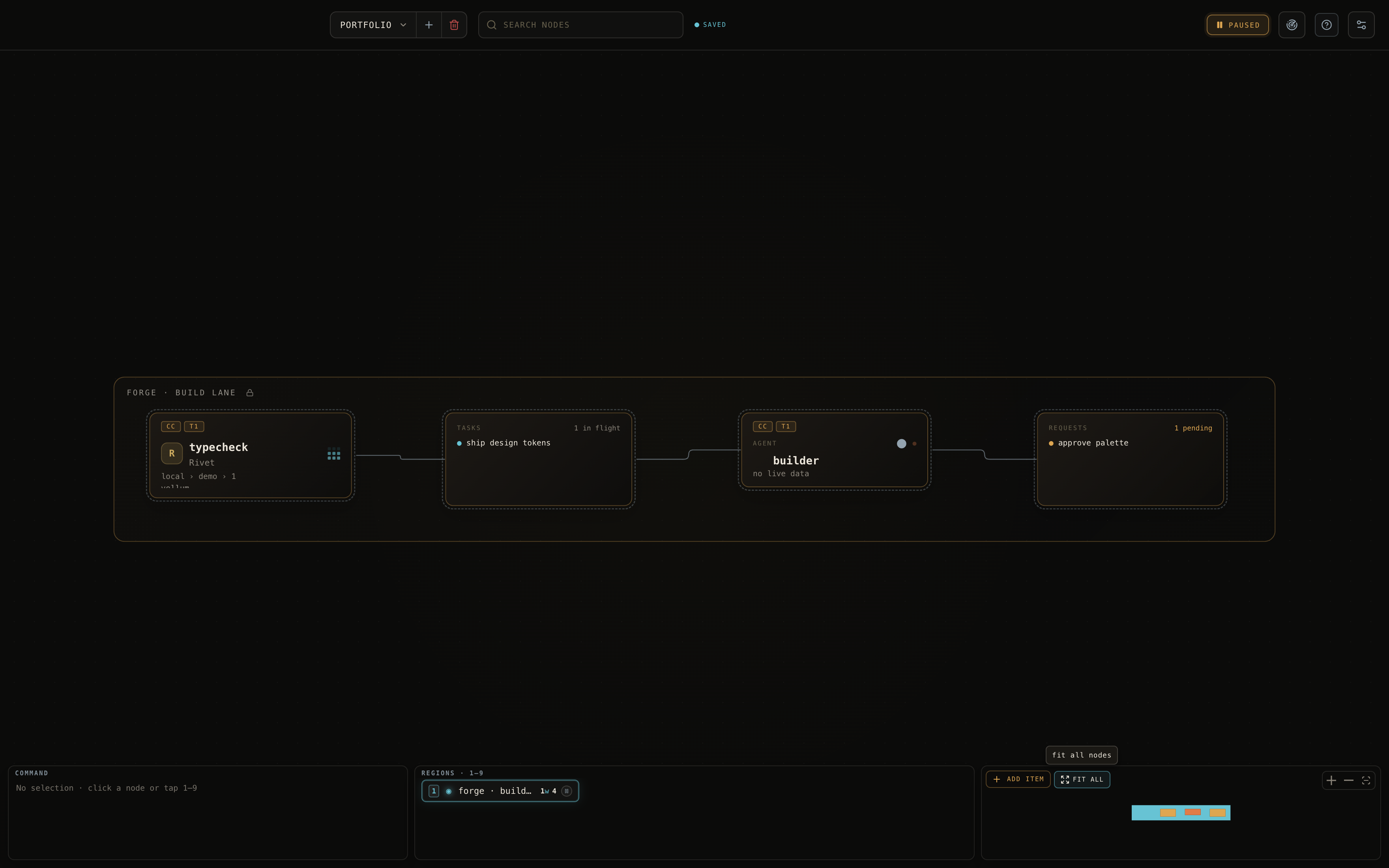
One line of work, drawn
A runner, a task queue, an agent, a request inbox — wired left to right. The wiring is the permission: this agent can reach this queue and nothing else. What you draw is what can happen.
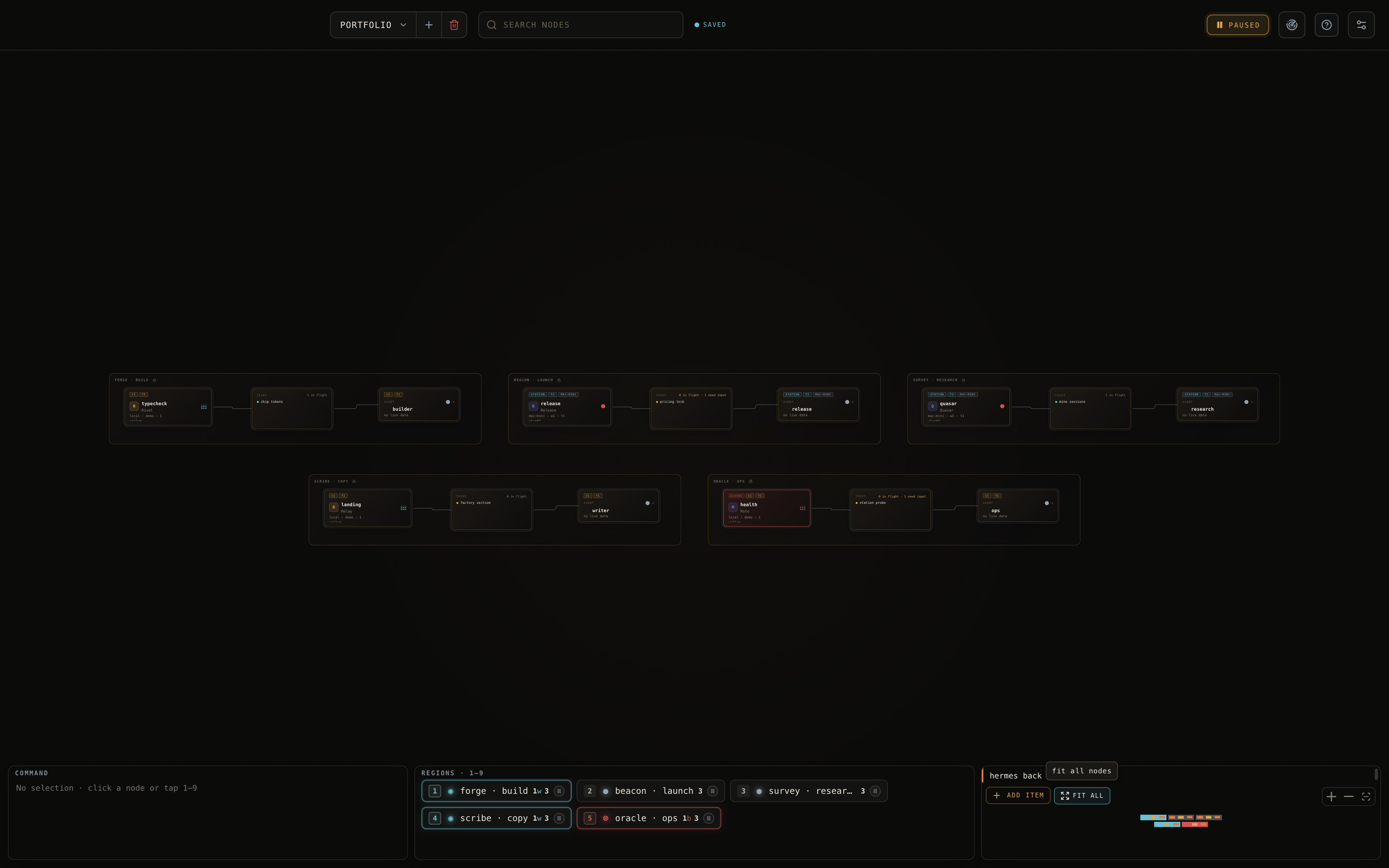
Five crews, one board
Not just code. Build, launch, research, copy, ops — each region runs its own crew with its own queues, and each is one keyboard tap away. Region summaries tell you which one needs you.
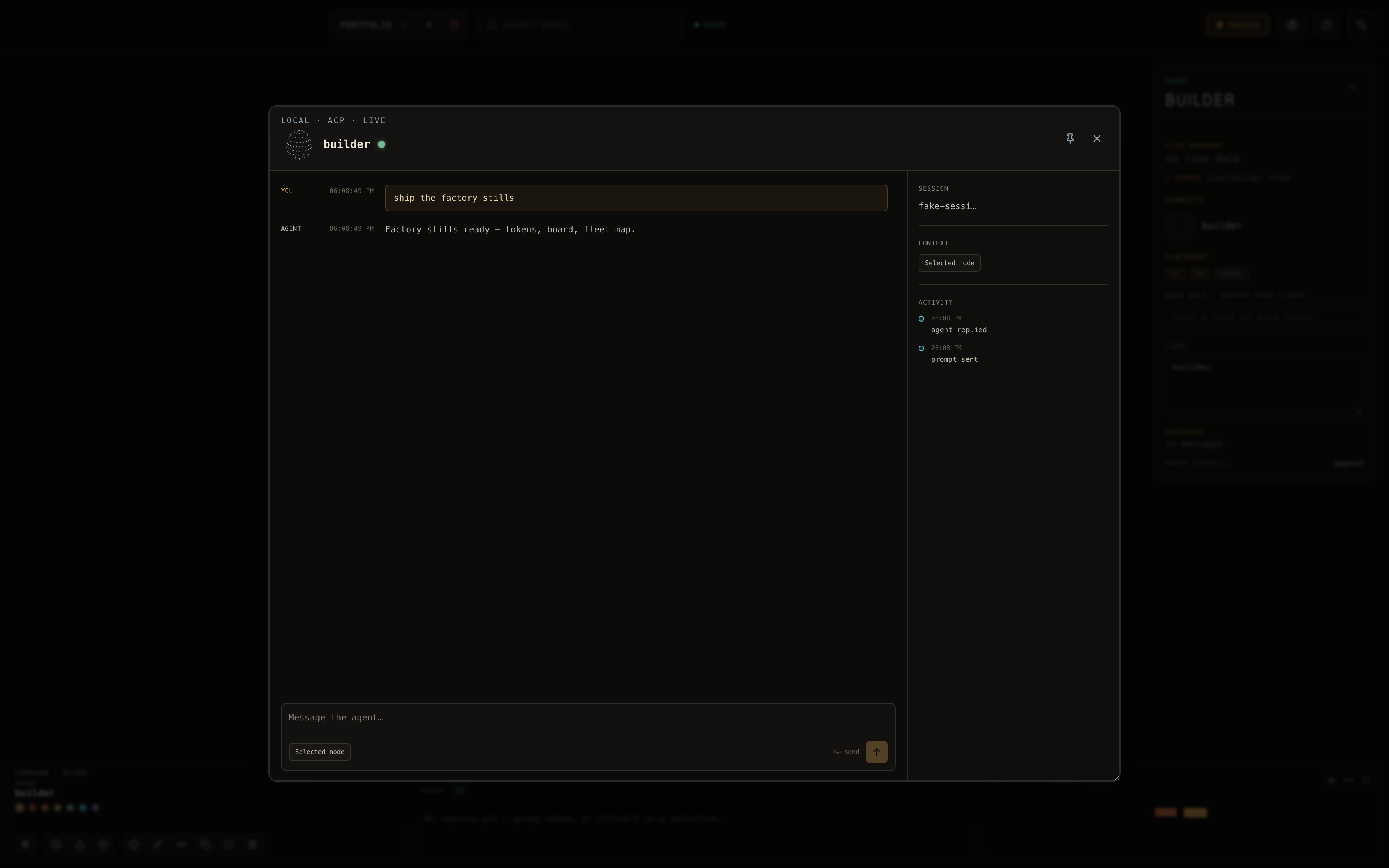
The plugin
Your agents wake up already briefed
A small plugin puts Vellum Command in your agents' hands — the agents you already run.
Briefed on arrival
The moment a session starts, the agent knows which card it is, what region it's standing in, and what the factory around it looks like. No pasted preambles, no stale context.
Work, not ceremony
It pulls tasks from the queues it's wired to, messages the agents next to it, and raises a request the moment it hits a decision only you can make. Escalating is one tool call, not a stalled terminal.
Gates, not promises
Finished work is submitted through the gates you drew. A proof gate clears only when the real artifact lands — metadata can't fake it. An approval gate clears only when you say so.
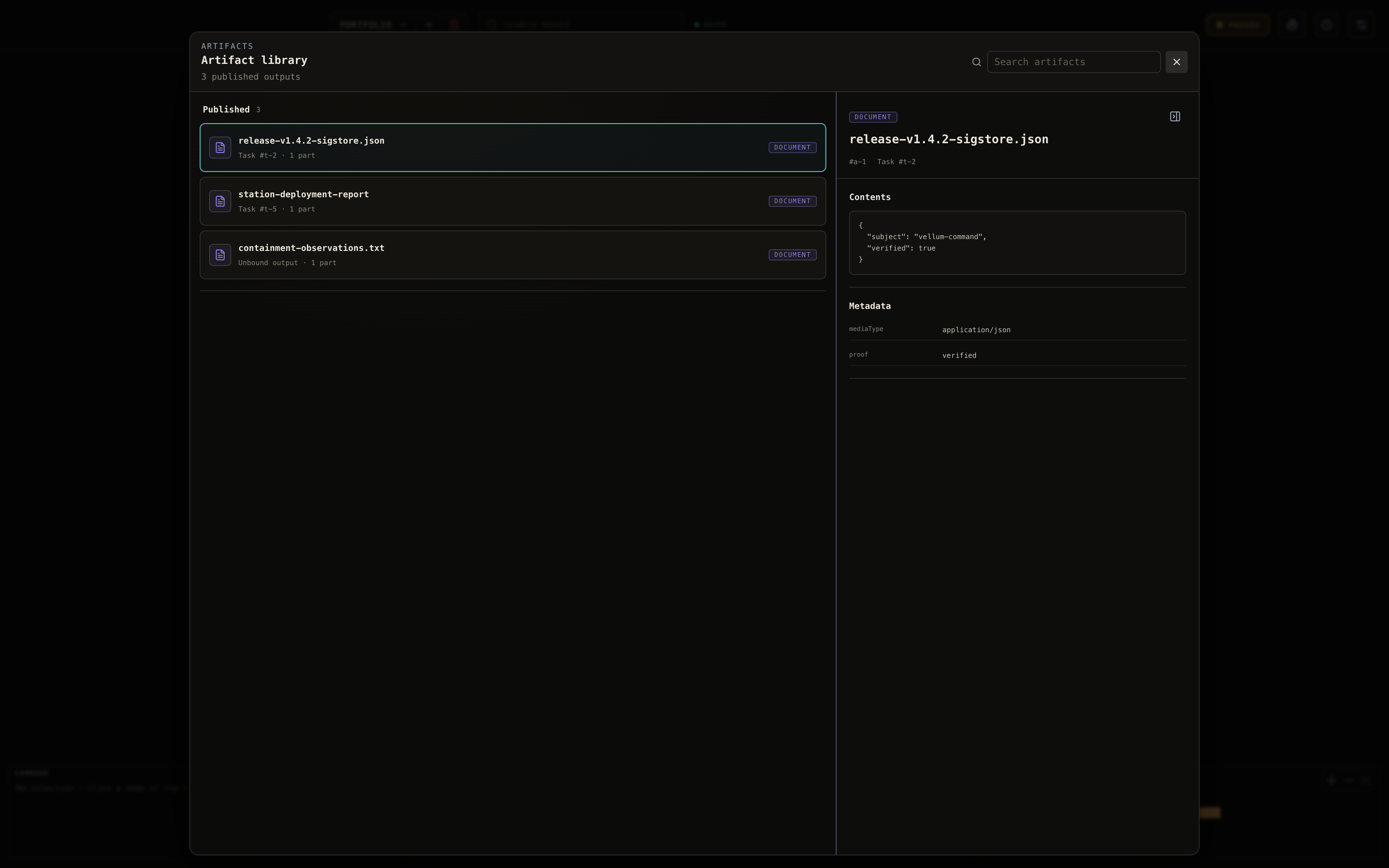
Every one of these is a mistake an agent physically cannot make: touching a queue it isn't wired to, reaching a machine you never placed it on, clearing a gate with words instead of work. The factory doesn't ask you to trust your agents. It's built so you don't have to.
Attention
When agents need you, you know
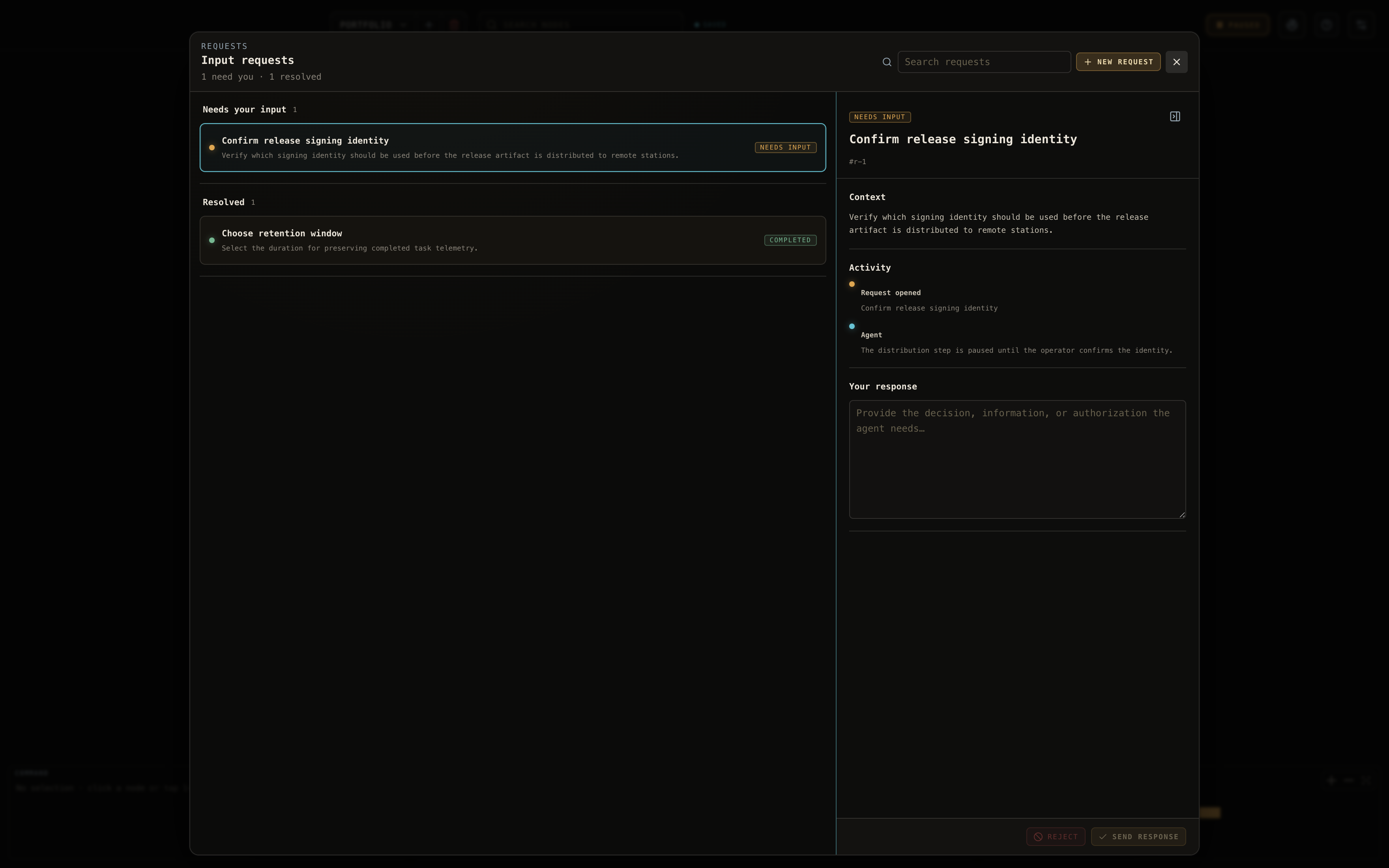
Escalation is first-class. When an agent hits a decision point, a missing permission, or a question only you can answer, it raises the flag — the card catches fire, the signal carries through its region, and the request lands in one inbox on the board. Organized, unified, across every agent you run.
You answer right there, and the answer reaches the agent immediately — it picks up where it stopped. No hunting through terminals and tabs for the one that's stuck.
It changes how agents behave, too. An agent that can't ask will guess — pushing through is where derailing and hallucinated "done" come from. When asking costs one tool call, you can be strict: escalate instead of assuming. They ask more, they guess less — and nothing just does stuff anymore.
Control
Nothing moves until you press play
Every board is born paused. Nothing acts — and nothing spends a token — until you press play. The first play tells you exactly what's about to start. And pause is everywhere: one card, one region, or the whole board — one click, everything stops.
If the review queue drains itself overnight, that isn't the software deciding. That's your decision, running. Autonomy here is your input — under constraints you can see, verify, and stop at every turn.
Your asset
The board compounds
Nothing you do here is throwaway. The wiring, the roles, the queues, every answer you give, every artifact your agents file — it all stays. After a month the board isn't a picture of your operation. It is your operation.
And it lives on your disk — a local store, plain JSON, no cloud copy. Any board exports as a JSON Canvas file that other apps open and git can diff. Agents report to the board; they don't own it. Cancel tomorrow and everything is still there, still readable.
export → ~/.vellum-command/canvases/portfolio.canvas
Privacy
Nothing leaves your machines
Everything stays local. Vellum Command makes exactly two kinds of network calls, ever: a license check and an update check. No analytics, no account, no telemetry. It's private because there's nothing to send — not because a switch is off.
The price
$79.99. Lifetime.
Vellum Command is $199 a year. The first 50 licenses are different: $79.99, one time — lifetime, every update included. After the 50, it's $99 a year for the next hundred, then $199.
- Lifetime license. Pay once, every update included.
- 3 Macs, one key.
- 14-day guarantee. Full refund, one email. No questions.
Early access · macOS 13+ · Apple silicon
This is early software. I run my whole operation on it, every day; the core is solid, some edges are rough. That's why the first 50 pay $79.99.
Manage dozens. Command hundreds.
A workstation you can full-screen and forget the world. Queue the work, press play, and answer only what needs you.
Early access · macOS 13+ · Apple silicon